Showing posts with label PTC8 - Learning Styles. Show all posts

Thursday, 14 November 2019

Positive Relationships


Positive Relationships @ FFC
14th November, 8:35 - 10am
Facilitator Belinda (former FFC student)


We began by introducing ourselves and sharing three facts - this was enlightening! 

Positive change office is in Greenwood St close to highly addictive Takeaways.

Started with Belinda discussing what she does and who she works with - a range of kids and adults who are in a various situations where they need support.

They learn about recognising where in their body's they 'feel' anger. Strategies are given to acknowledge their anger and recognise that they are in unsafe situations - "unsafe for me and unsafe for others".

Physical signs match up with their emotions such as throwing, punching, kicking, fast breathing and swearing (verbal abuse/harassment).

For our students, they need to find out where their safe place is. They need to know that they have a safe place and take some time out to work on the way they are feeling.

How well do we know I students? How do we manage that? Assert the boundaries, but also show love and offer a safe environment. Learn about their backgrounds and the environments where they come from/what they are going through.

Going on this course, students learn that their beliefs are what determine who they are, how they act etc. Their beliefs are what determines how they react in unsafe situations and what they are protective of. If for example, Whaanau is really important they will go to any length to protect their Whaanau.

Learning to understand that their beliefs can change and this is OK. O0ur beliefs may not align with a students or their whaanau. As a group we discussed what is our beliefs are and why they are important.

Communication Styles:
- Passive: Compliant, submissive, talks little, vague non-committal communication, puts self down, praise others.
- Assertive: Actions and expressions fit with words spoken, firm but polite and clear messages, respectful of self and others.
- Aggressive: Sarcastic, harsh, always right, superior, know it all, interrupts, talks over others, critical, put downs, patronising, disrespectful of others

Students identify their traits from each category and decide what percentage of each they are and what they need to work towards.

How to be assertive/submissive/stick to the facts: lowering your body position and sitting by the person. 
Use a compliment sandwich: Bread, something they did well - filling is the concern/complaint - Bread - something else.

We were given little bits of paper with scenarios - deadlines not meant/silly behaviour

Agree to disagree is something they need to be taught and discuss that it's ok to have an opinion. Accept that sometimes people won't reason with you - just work on not responding with aggression

How do alcohol and drugs affect our lives/whaanau? The kids were asked these questions and wrote their thoughts on a big piece of paper. Belinda shared the fact that so many kids smoke weed and so many of their home environments are immersed in drugs. Also discussed with the kids, especially the girls, how vulnerable they are when they are intoxicated and how they can look after themselves.

Te whare tapa wha. Both the negative and positive effects are discussed with students. Because this is also taught in our school, the kids clicked on straight away.

Power and control - domestic violence. This session is heavily monitored because of the sensitivity and impact on kids. Identifying that it is learnt behaviour - perpetrators are 80% males, 20% females. Abuse, family violence affects the whole family and also their pets. Discussing with the kids how this is not the norm in every family and how to ensure they are safe.
There is a increased chance of becoming a perpetrator if you are male and the male role model in your life is abusive and also becoming the victim if you are female and a female role model is being abused.

A safe environment is so important to these kids. 

Healthy Relationships at FFC
Negotiation and fairness
Non threatening behaviour
Respect
Trust and support
Honesty and accountability
Responsible parenting
Shared responsibility
Economic partnership

We filled in our thoughts on a triangle piece of paper with different titles from the list above of healthy relationships. Interesting thoughts from each group!
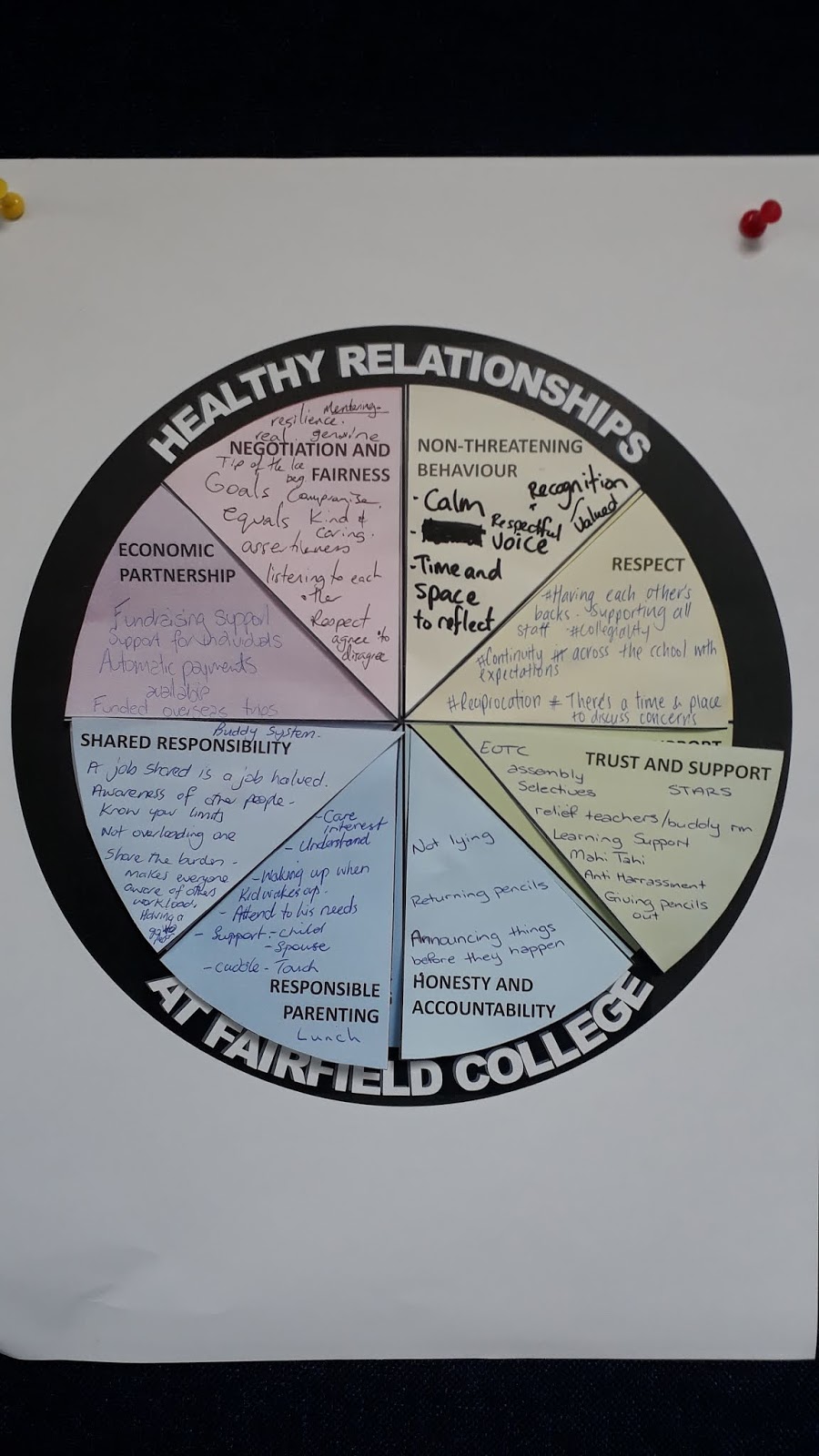

Dealing with the spectrum of attitudes and behaviours in our school can be challenging, so this type of PD is AWESOME!!

Healthy teachers and healthy students = a healthy FFC


Monday, 26 August 2019

SOS Faculty Meeting


RCE
If we need any resources - email with a request.
Relief - ensure we are leaving specific lessons that link to the current topic and enough to cover 90mins - I feel confident that I leave appropriate tasks for relievers and never leave a note saying 'the students know what we are currently doing' - cracks me up , because the students would always claim they know nothing and try to get away with doing zilch!

SMA
Shared work that his students have done. Encouraging us to incorporate more hands on tasks such as crafty ones that involve the students researching and making specific landmarks or natural features. SMA called it Master Builders and had the HOF judge the students work based on pre-constructed criteria - including the history and it's significance to the local culture.

SMA has also introduced a Board Game assessment. Students created a Snakes and Ladders game that again had specific information relating to the current topic - questions were asked about countries and their capitals. Students conducted research, made their board and tested one another through play.

MVB
Gamification - learning through gaming. MVB has been studying through Mind Lab .
Students used the game Mindcraft to build specific natural features or landmarks from their chosen country. There were some technical issues. However, what the students had created was awesome! Their were some that had no previous experience with the game and struggled somewhat - however they persisted and really enjoyed the task.


Videos of the construction process were taken to assess their knowledge.

Another media-based tool for show casing learning was Stop Motion app. This was a great way to engage a range of learners - creating short videos about their chosen country and/or how landmarks were made.


Tuesday, 18 June 2019

Education Perfect PLD


3:20 - 4:15
Brian from Education Perfect

Brian went through a range of ways we can use Education Perfect for Science/Maths/English. Next term we should be able to use this for Social Sciences - I have previewed a number of tasks that would be suitable for when we are looking at the Treaty of Waitangi. Some of the tasks may have been useful for the Antarctica unit.

Setting tasks
Analysing student achievement - Diagnostics
Setting assessments
Emailing parents results - most likely want to do this on an individual basis.

Double check ratio of questions to lessons - minimum of 5 questions is recommended. 


I have set up a 'test' for 10A Math

Monday, 18 March 2019

Staff PLD


FHO – Write that essay

-      2 year plan
-      Target group: Yr 9 & 10
Post writing Strategy
After writing, introduce two rules (sentence with 18 words; reading aloud). This is based on evidence from research.
They need to think about the size of their sentences. Helpful for reluctant writers and ‘over’ writers.
Reading aloud you can hear your pauses and often come across errors.
The perfect student: these strategies won’t work with students who already write well.


Activity Ideas
Series of short sentences that they can recraft using the two rules- needs to be relevant.
Use work from previous students - apply the two rules.
Use an example of their work to develop as a class - split sentences up; count how many words (highlight them); recraft; highlight first two words; look at sentence starters...
Success Criteria: Develop the control of a sentence
Term 2 Target: All year levels
There are more workshops coming up. At this point in time teachers from ENG and SOS will be given this opportunity. 
Further development opportunity for another teacher to focus on level two.
Another workshop on paragraphing will be available later in the year - maybe one teacher from 

What do we do now - use these two strategies in our classes!! Discuss with our HOF's if we would like to participate in any workshops.


BMA
Pastoral entries.
We need to input pastoral notes correctly - we need to make sure we are putting the note into the correct category and including the correct teacher code/s. In group entries, make sure we do not use the students names - initials are OK. Professional language needs to be used. 
I feel like my KMAR entries are done correctly. 


MCH
Collaborative inquiry - second one can be moving on from the first (digging deeper).
We are using the six standards and links to Mahi Tahi.
Gathering evidence for our teacher appraisal. We have been sent the appropriate docs by email.
Gathering evidence shows that we have participated. Evidence that demonstrates how we meet the standards we keep ourselves.
Everyone will be observed twice, there will be PD on how to do this. Observe for 5 mins; write furiously for 10; observe once more,  note any changes/extra info.
Gathering evidence; making sense of the information gathered; discussed with the person you have observed.
Term three and four - digging deeper.


Wednesday, 6 March 2019

Teacher Only Day - Write that Easy


TOD 6/3
Write that essay programme – Sentence Workshop
Andrew - His job is to give us strategies to help our students demonstrate understanding on the page.
“Put the child at the centre of it”
What do our students struggle with?
-      Spelling – inventive or just terrible
-       Focus – disinterested
-      Confidence (giving up because they don’t feel like they get it -
-       Articulating – vocab – subject specific vocab
-      Structure – lack of grammar – surface or deeper
-      Retention
-      How to start – confidence and interest - fear of failure – task is too daunting.
-      Understanding – comprehension
-      Deeper thinking
-      Writing style
-      Organising ideas – paragraphs – blocks – sequencing information – logic
-      Repetition
-      Paraphrasing
We were given the task of writing for five minutes on any topic, and then share our writing with a partner. There were common experiences that our students go through - unsure what to write – change topics halfway through – terrible spelling.
Precision, focus, knowledge
Concentration of simple sentences – we want our students to have an arson to show they are fluent.
We analysed our own writing, putting a double line by full stops and counting how many words were in each sentence.
The best way to change a short sentence is to introduce different styles
-      A very short sentence – 5 words or less (use this in the middle or the end of their paragraph)
-      ‘W’ start sentence - Use a comma after the W phrase – the start of analytical writing.
-      Adverb Start Sentence – write the adverb then add a comma! ‘Interestingly, the chicken is not the smartest animal.’ This helps them bring their own voice to their writing. Adverb start: Interestingly, desperately, surprisingly, calmly, and solemnly.
-      Em-Dash sentence – use 5-6 words if not listing. Adds ‘colour’. The All Blacks fierce, determined, unbeatable had a bad day at the office. Helps you bring in your voice.
-      Explore the Subject Sentence – double comma rule. Introduce an idea: The road, which was a popular route with tourists, was only crossed by stupid chickens. This is an analytical sentence.
“It’s not just what you say, it is teaching your students how to say it…”
Recrafting – empower them with multiple opportunities
-      Read aloud
-      Count the words in isolated sentences
Conversation - communicate in phrases – complete thoughts.
The burden of content should be removed from the child – isolate the skill (application of different styles) – use a model and ask how they would recraft…
Collaborative Short Story – CJA, SWR, BMA, MMA
Federico Elf, who was the star football player for Melville United, was struggling because he had lost his “football undies”
Surprisingly, this agitated his mother Jayne on route to Gower Park.
Whilst arguing aggressively, Jayne’s inability to multi-task became evident.
She ran a red light.
“BANG”
With a sudden jolt, Frederico’s dreams of beating the Pink Flying Elephants team were shattered.
Calmly, Jayne – with a Y – rang an Uber and fled the scene, along with her screaming son.
Uber came through, along with Lone Star “Redneck Ribs”; successfully getting Frederico Elf to his game on time.
Moral of the story – there is no such thing as can’t!
RECAP
Providing strategies and the 12 ways will enable consistency across the board.
Encouraging student collaboration when writing is a useful starting strategy.
Break down habits in order to relearn new ones – high achieving students are less likely to fell failure.


Tuesday, 13 November 2018

Term 4 Co-Construction


The last round of co-construction for 2018!! The format has slightly changed with the meetings being held today and a presentation of information given tomorrow in the Whare.
I have been given the roll as facilitator, which I don't mind - just not terribly impressed with having to do the presentation down at the wharenui on the 13/11 - how on earth is this going to look and how much extra time do we need to spend on preparing this?! 

3:30
FHO ENG: Discussed e-asTTle testing and Y9 collective; low level student needs; high level learner extension; management strategies; multi-modal learning opportunities.
RNA MAT: Students of concern; self-management improving; extending high level learners; identifying low level learners and strategies to motivate/manage.
CJA SOS: Took student's books as examples and discussed their work ethic/self-management and behaviour in class - big changes throughout each term. A lot of students are needing a second book; low level learner engagement and how that looks in SOS; my strategies to motivate; multi-modal learning structure.

We discussed what Maaori achievement looks like in this core class and how we can enable these learners to succeed. We all agreed that there are some high level Maaori students in this class as well as low level. We have a mix of strategies to engage and motivate these learners. In some cases lack of attendance is a hindrance to their success. 

Presentation: We decided to use adjectives to describe the class each term. The adjectives will all start with B because the core class is 9B. FHO trying to think outside the box for our presentation instead of just rattling off goals and anecdotes. We came up with a range of adjectives starting with B that we think fit the way the class evolved (academically and socially) throughout the year. Quite looking forward to seeing how other core groups are presenting.  

It's always nice to be provided with little snacks after a long day - the food was blessed prior to the start of the meeting as per the routine. 


Update: 13/11
The final Co-construction was held down at the Aratiatia Marae. We gathered in the whare kai for some afternoon tea and then headed into the Marae for each group to share their learning and knowledge of each Year 9/10 core group.
There were a range of presentations - was very impressed with the singing, rapping etc.!
FHO, RNA and I had a list of adjectives beginning with B to describe the class each term - we got a few laughs!
The Marae was a really nice setting to bring us all together.

Wednesday, 31 October 2018

Year 10 - Button Holes


Inserting button holes can be incredibly challenging for both the students and myself! Because there are two different types of sewing machines in the classroom, I decided that this group of Year 10's will learn how to use both machines to insert a buttonhole. The picture below is of the instructions the students copied down in order to use the Bernina 1008 - one of the older style machines in the class. 
There were mixed results - some successful, some not so. The students were in pairs and used a small piece of calico to practise. Some of the machines were cooperative and a couple of pairs produced three or four practise button holes, whilst other machines played up and frustrated the hell out of the students.
With 30 minutes of the lesson to go, I showed them the automatic buttonholer on the Bernina B330 - this is the quick method! They were astounded at the simplicity and the speed at which a buttonhole was produced!
In the past I have only demonstrated the automatic buttonholer, and students were not appreciative of the ease in which this method creates a buttonhole!
I have always got to remember to get the students to use iron-on interfacing to strengthen the area the button will be inserted, otherwise the fabric tends to get 'eaten up' by the machine!


Friday, 26 October 2018

Textile's EOTC


I was able to take a group of year 12 and 13 students up to Auckland to visit the Zambesi work room on Tuesday, 23rd October.
We left school just after 8am and arrived at the work shop by 10:30, after being stuck in numerous delays on the Auckland motorway. 
We were shown around the work room by Liz Finlay (owner/designer) and able to gain first hand insight into how the industry operates - and in particular how Zambesi functions. The students were able to see everything from office work to pattern drafting and garment construction.
Liz was a truly fabulous host. She kept it very real - she didn't sugar coat anything!
We were fortunate enough to get to view the Zambesi Winter 2019 collection and spend time looking over garments and discussing elements of design as well as techniques undertaken to construct the garments. No photos were taken during that point of the visit!

 Before we left Auckland, we went to The Fabric Store to peruse the range of fabric and notions they have. The store was much larger than we anticipated and we met one of the Project Runway NZ contestants!

If we were to do this again, I would leave a lot earlier than 8am - to ensure that more time is spent in Auckland - and possibly visit a Zambesi store.
This was an amazing opportunity for the students and they were an absolute pleasure to take. I'm looking forward to doing this all over again, and possibly visiting other NZ labels.

This is a pic of the blog post on the Textile's blog. I shared the link with the FFC staff and have been getting really positive responses. I'm also hoping they will look at other aspects of the blog!! 


This is the slide show of the photos taken throughout the day


Sunday, 4 March 2018

Textile's - Education Outside the Classroom

Have sent an email to the iconic Kiwi fashion label, Zambesi, in the hopes that they will sponsor the Year 13 Textile’s students to attend NZ Fashion Week 2018. This would be an amazing experience for them and of course for me!!! I was fortunate enough to complete two weeks work experience with them in 2002 and have remained in touch through a mutual relative. Looking forward to any kind of response.

Friday, 24 November 2017

Report Writing, Term 4

Report  writing for term four, has been exhausting! I had to complete report for four Junior classes: 9TET; 10TET; 9FOT; 9ENG - with a total of 72 students. I started on the Textile's reports, chipping away at them from about the second of November.
Textile's and Food Tech were completed and handed to AFI for editing on November, 24th. 
By Friday, I had four English reports to complete and they were done by the end of the school day on the following Monday. I found these ones the most challenging to write. There are a huge range of levels in this class and low attendance - which means tasks are often incomplete. Thank goodness KMAR is available through remote connection!


Co-construction Meeting - Term 4, November


This was our last co-construction meeting for the year. I was really impressed to see more of what the other Technology teachers at FFC teach/make in their classes. Sharing ideas, discussing learners, challenges, highlights and future ideas.

BCH – China trip was the highlight. Challenges were home sickness and tricky connections with home-stay families. The group were worried about the performances they had prepared because some students weren’t taking it seriously – this did resolve itself when they were in China and students were proud of themselves. BCH made a school banner to take with them to the various schools and places they visited. Students had the best opportunities to be immersed in the Chinese culture at the schools.
BCH uses songs to teach the junior students rather than having to repeat phrases over and over.
GSN – Year 9’s have been working on small cars, learning to use the lathe and other machinery. Year 10’s have been making metal garden tools and used torches to weld and anvils to flatten. In graphics they have been doing concept development of ways to present their names as a 3D model. These are then printed out by a 3D printer.
MSA – Basic electronic circuits etc. to be able to program a robot. The robot has a task it has to complete. They are given codes and sensors to modify. The students really like this task because they enjoy the final product.
SSC – Building websites using a range of apps. The difficult part is getting them to write in their blogs using complete sentences and detail. Some have created very basic blogs with images. Geoguessr – a great game to entertain students and educate them without them realising.
SKE – Year 10’s have finished composition – writing lyrics and composing the music themselves. Some will be performing at the junior prize giving. Lyrics are written first because that’s the hardest task. Some students collaborate. Two assessments are done, a song and a performance. Loads of challenges but the end result is always amazing.
JWA – Uses Code Combat to introduce students to coding – always looking for tools to teach coding. Gamification – adding elements of games into learning. Lots of choices to make in terms of characters and solving puzzles, codes are used to solve the puzzles. Differentiates with learning – students can go back and finish previous tasks or develop them. A graphics tablet has been brought to
KRO – Has previous students presenting at an exhibition for their art degrees. Students work through portfolios learning about colours and perspective. Juniors are scaffolded to be able to develop the knowledge and skills to do NCEA art.
RTE – Creating a large wooden box with a sliding lid. Carbon paper to decorate, etched designs and then sanded and varnished.
JWR – Food Tech has a healthy eating focus for Year 10’s – hauora and food groups. Students create posters to display their knowledge of the four food groups. Students move on to design a weekly eating plan that meets the needs of daily requirements. 

Monday, 25 September 2017

Senior Report Comments

Senior report comments are due again this Wednesday. Thank goodness I only have one senior class!
We have a great collaborative system in our office. Julie printed off her completed report comments for me to look over/edit, as well as to inspire me to complete mine. This editing needs to be done before it gets sent to AFI for final submission.

Below are JWR's report comments that I had the pleasure of editing this afternoon (double-sided).


I've completed all of mine and will be printing these off tomorrow for JWR or SHA to edit.


Thursday, 21 September 2017

Textile's at Lunch Time

Quite often I open the Textile's room at lunch one and two on Thursday's and Fridays for students to continue working on tasks. This week I have had both year 9 and 10 students working through their lunch times - screen printing and sewing.
I enjoy this time with students, as I can often have really great chats about their tasks and what they are finding challenging. I encourage a growth mindset in the Textiles room. Sometimes tasks are really challenging, but a positive attitude will see you through. I encourage students to learn from their mistakes and to persevere. The tua-kana-teina approach works really well in this class. I believe it is not only beneficial for the students to share their knowledge and skills with one another, but to also be able to rely on their peers/classmates to guide them - often I am busy helping out and can't get to everyone in a timely manner. 
I have found as each term progresses, the more positive relationships I have built with students, and the more I learn about myself as a teacher, I love this job even more!!


Wednesday, 20 September 2017

Teacher's Only Day - Faculty Meeting


Working on year 11 assessment standards for 2018. Remembering that there is a 10 credit/2 standards limit.
Discussed with Aimee the benefit of including an AS that contains Literacy credits and the potential for all Y11 students to be successful. Aimee suggested I offer another assessment standard that allows the lower level learners to also achieve success.
By the end of this work day I will have set the level one assessment standards for 2018 and have a basic outline of a yearly planner. 

This was discussed with AFI and has been sent through email to then be shown at the next HOF meeting


Friday, 8 September 2017

Quick Writes - 9G English

I introduced the students of 9G to the idea of Quick Writes (this was something I used in previous classes at BNMS). A quick write is designed to get students writing. They are provided with a picture/word/sentence prompt and given 5-8 minutes time to write. The prompt is unpacked/discussed at the very beginning.

9G took to this form of writing quite quickly. They mostly enjoy humorous/adventurous picture prompts. The time limit set is usually from 5-8 minutes. I judge whether they are in the right 'head space' as to whether or not they get a longer period of time to write. 
Before 9G had speeches, I brought in the new expectation that they had to read their work aloud to one person in the room. At times they are resistant to this! With VMA or JFE in the room to assist, they eventually follow through. Sometimes, a student is willing to read aloud to the whole class (this option is always presented, but hardly ever taken up), and this is usually the same student time after time. As in the first picture below, he likes to read his story's to me outside of the classroom - I am always happy to oblige students who want to read aloud to me outside the class room. 

This has become a regular task completed in Thursday's period 5 class

Next term, my goal is to introduce them to sentence/word prompts.