Showing posts with label PTC1 - Relationships. Show all posts

Thursday, 14 November 2019

Positive Relationships


Positive Relationships @ FFC
14th November, 8:35 - 10am
Facilitator Belinda (former FFC student)


We began by introducing ourselves and sharing three facts - this was enlightening! 

Positive change office is in Greenwood St close to highly addictive Takeaways.

Started with Belinda discussing what she does and who she works with - a range of kids and adults who are in a various situations where they need support.

They learn about recognising where in their body's they 'feel' anger. Strategies are given to acknowledge their anger and recognise that they are in unsafe situations - "unsafe for me and unsafe for others".

Physical signs match up with their emotions such as throwing, punching, kicking, fast breathing and swearing (verbal abuse/harassment).

For our students, they need to find out where their safe place is. They need to know that they have a safe place and take some time out to work on the way they are feeling.

How well do we know I students? How do we manage that? Assert the boundaries, but also show love and offer a safe environment. Learn about their backgrounds and the environments where they come from/what they are going through.

Going on this course, students learn that their beliefs are what determine who they are, how they act etc. Their beliefs are what determines how they react in unsafe situations and what they are protective of. If for example, Whaanau is really important they will go to any length to protect their Whaanau.

Learning to understand that their beliefs can change and this is OK. O0ur beliefs may not align with a students or their whaanau. As a group we discussed what is our beliefs are and why they are important.

Communication Styles:
- Passive: Compliant, submissive, talks little, vague non-committal communication, puts self down, praise others.
- Assertive: Actions and expressions fit with words spoken, firm but polite and clear messages, respectful of self and others.
- Aggressive: Sarcastic, harsh, always right, superior, know it all, interrupts, talks over others, critical, put downs, patronising, disrespectful of others

Students identify their traits from each category and decide what percentage of each they are and what they need to work towards.

How to be assertive/submissive/stick to the facts: lowering your body position and sitting by the person. 
Use a compliment sandwich: Bread, something they did well - filling is the concern/complaint - Bread - something else.

We were given little bits of paper with scenarios - deadlines not meant/silly behaviour

Agree to disagree is something they need to be taught and discuss that it's ok to have an opinion. Accept that sometimes people won't reason with you - just work on not responding with aggression

How do alcohol and drugs affect our lives/whaanau? The kids were asked these questions and wrote their thoughts on a big piece of paper. Belinda shared the fact that so many kids smoke weed and so many of their home environments are immersed in drugs. Also discussed with the kids, especially the girls, how vulnerable they are when they are intoxicated and how they can look after themselves.

Te whare tapa wha. Both the negative and positive effects are discussed with students. Because this is also taught in our school, the kids clicked on straight away.

Power and control - domestic violence. This session is heavily monitored because of the sensitivity and impact on kids. Identifying that it is learnt behaviour - perpetrators are 80% males, 20% females. Abuse, family violence affects the whole family and also their pets. Discussing with the kids how this is not the norm in every family and how to ensure they are safe.
There is a increased chance of becoming a perpetrator if you are male and the male role model in your life is abusive and also becoming the victim if you are female and a female role model is being abused.

A safe environment is so important to these kids. 

Healthy Relationships at FFC
Negotiation and fairness
Non threatening behaviour
Respect
Trust and support
Honesty and accountability
Responsible parenting
Shared responsibility
Economic partnership

We filled in our thoughts on a triangle piece of paper with different titles from the list above of healthy relationships. Interesting thoughts from each group!
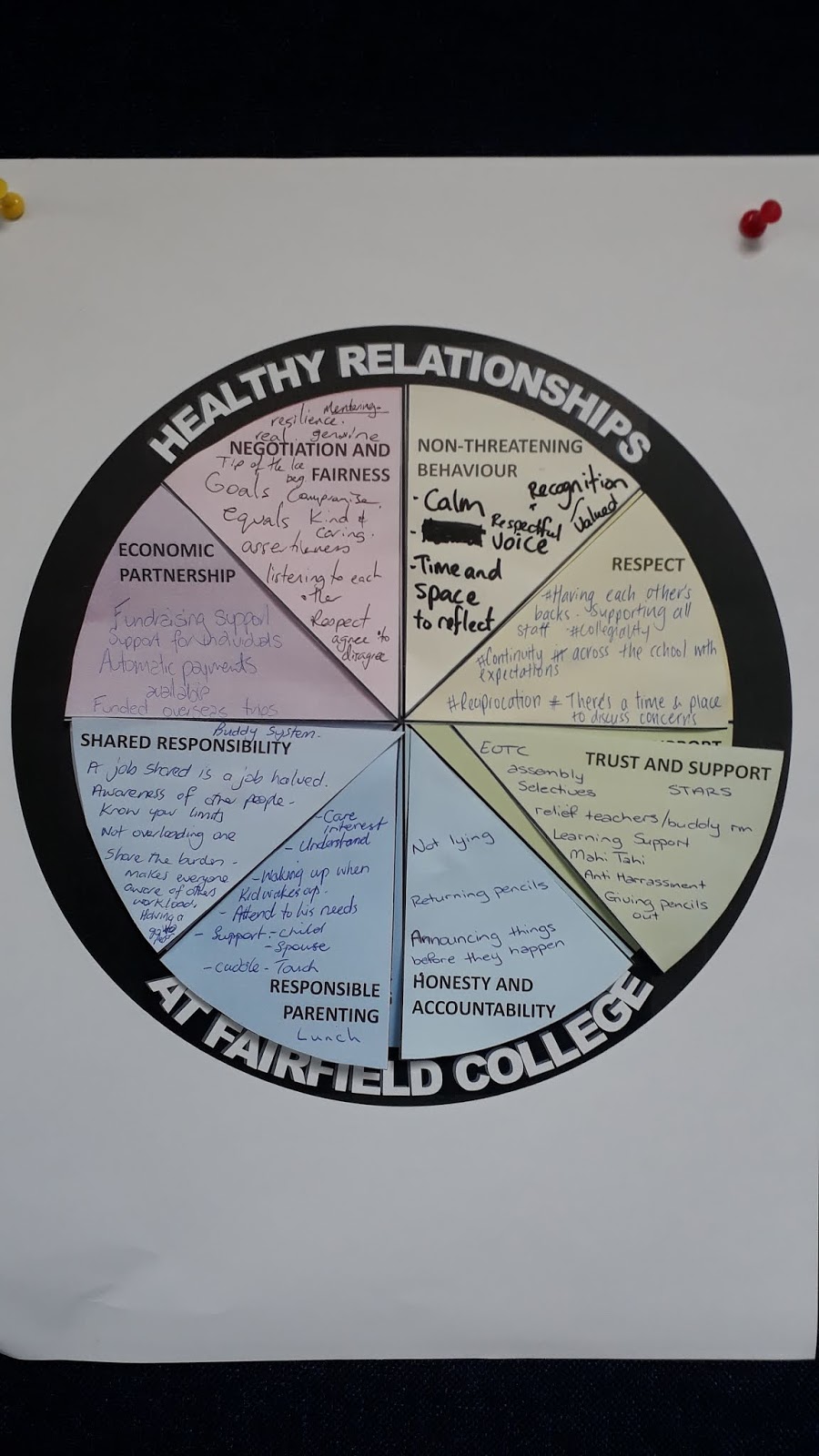

Dealing with the spectrum of attitudes and behaviours in our school can be challenging, so this type of PD is AWESOME!!

Healthy teachers and healthy students = a healthy FFC


Friday, 13 September 2019

PL - Culturally Responsive Pedagogy


Professional Learning - September 13th

Karakia timatanga
Kia hore te marino
Kia whakapapa pounamu te moana
Hei huarahi maa taatou i te rangi mei
Aroha atu, aroha mai
Taatou i a taatou katoa
Hui e! Taaiki e!

Poutama Pounamu – Rawene: supporting our mahi; Across Schools Kaiako - Jimmy: Bankwood Primary; Nga Huia

"Excellent education from a cultural experience" - Rawene

3 Phases, involves looking at data. Understanding as an individual and as a group to come up with an action plan, so we have a more integral involvement.

MMA
Formed a donut with an inside and an outside circle. Moved around to discuss different questions with colleagues. Why did we become a teacher? What keeps us teaching here? What is culturally responsive pedagogy? What would we like to know about engaging in culturally responsive pedagogy?
Back into table groups to write down any thoughts we had about culturally responsive pedagogy.


Using the reading with a partner to discuss the main points of the reading 'Cultural relationships for responsive pedagogy, A bicultural mana orite perspective" Mere Berryman, Dawn Lawrence, and Robbie Lamont.

Discussed the main points of the reading and wrote down 3 main points.

Joined with two others from other pairs and discussed the three main points we each had and why/how they are important to effective culturally responsive pedagogy.

How are we being culturally responsive teachers at FFC.

Key things to achieve today - questioning ourselves and why it is important to be culturally responsive and incorporate that into our pedagogy. We need to take ownership, investigate and reflect on our practises. 

Closing Karakia


Wednesday, 21 August 2019

Akotahi - Mahi Tahi


3:30 - 4 Meeting with RCR, RCE, MWI, CMA and I - JFE away

Discussed what we know - what is happening in Akotahi. 

"We need to ask good questions to get good answers!"

What is the goal of Akotahi?  It would be very interesting to see how staff and students answer this question.

We shared information about what we know about Akotahi, as a Pouako, Dean, HOF, Timetabler, and Principal.

Hunches - what we investigate
- Structure
- Academic/Pastoral/Mountain focus
- Support
- Attendance
- Tikanga Maaori
- Cultural 

RCE will be creating a questionnaire based on the hunches we had - to collect data.

Monday, 18 March 2019

Updating the Textile's Blog

This is the image that I am trying to upload as the title on the Textile’s Blog. I'm having trouble with the size of the JPEG/PNG and resizing it to fit. I've spent some time trying to alter it, but definitely need help! 


Wednesday, 6 March 2019

Teacher Only Day - Write that Easy


TOD 6/3
Write that essay programme – Sentence Workshop
Andrew - His job is to give us strategies to help our students demonstrate understanding on the page.
“Put the child at the centre of it”
What do our students struggle with?
-      Spelling – inventive or just terrible
-       Focus – disinterested
-      Confidence (giving up because they don’t feel like they get it -
-       Articulating – vocab – subject specific vocab
-      Structure – lack of grammar – surface or deeper
-      Retention
-      How to start – confidence and interest - fear of failure – task is too daunting.
-      Understanding – comprehension
-      Deeper thinking
-      Writing style
-      Organising ideas – paragraphs – blocks – sequencing information – logic
-      Repetition
-      Paraphrasing
We were given the task of writing for five minutes on any topic, and then share our writing with a partner. There were common experiences that our students go through - unsure what to write – change topics halfway through – terrible spelling.
Precision, focus, knowledge
Concentration of simple sentences – we want our students to have an arson to show they are fluent.
We analysed our own writing, putting a double line by full stops and counting how many words were in each sentence.
The best way to change a short sentence is to introduce different styles
-      A very short sentence – 5 words or less (use this in the middle or the end of their paragraph)
-      ‘W’ start sentence - Use a comma after the W phrase – the start of analytical writing.
-      Adverb Start Sentence – write the adverb then add a comma! ‘Interestingly, the chicken is not the smartest animal.’ This helps them bring their own voice to their writing. Adverb start: Interestingly, desperately, surprisingly, calmly, and solemnly.
-      Em-Dash sentence – use 5-6 words if not listing. Adds ‘colour’. The All Blacks fierce, determined, unbeatable had a bad day at the office. Helps you bring in your voice.
-      Explore the Subject Sentence – double comma rule. Introduce an idea: The road, which was a popular route with tourists, was only crossed by stupid chickens. This is an analytical sentence.
“It’s not just what you say, it is teaching your students how to say it…”
Recrafting – empower them with multiple opportunities
-      Read aloud
-      Count the words in isolated sentences
Conversation - communicate in phrases – complete thoughts.
The burden of content should be removed from the child – isolate the skill (application of different styles) – use a model and ask how they would recraft…
Collaborative Short Story – CJA, SWR, BMA, MMA
Federico Elf, who was the star football player for Melville United, was struggling because he had lost his “football undies”
Surprisingly, this agitated his mother Jayne on route to Gower Park.
Whilst arguing aggressively, Jayne’s inability to multi-task became evident.
She ran a red light.
“BANG”
With a sudden jolt, Frederico’s dreams of beating the Pink Flying Elephants team were shattered.
Calmly, Jayne – with a Y – rang an Uber and fled the scene, along with her screaming son.
Uber came through, along with Lone Star “Redneck Ribs”; successfully getting Frederico Elf to his game on time.
Moral of the story – there is no such thing as can’t!
RECAP
Providing strategies and the 12 ways will enable consistency across the board.
Encouraging student collaboration when writing is a useful starting strategy.
Break down habits in order to relearn new ones – high achieving students are less likely to fell failure.


Monday, 18 February 2019

Staff Meeting - PLD 18th


FFC NCEA Achievement Data 2018
RCR Goal – To achieve the “national standard”
There’s been a decline
What do we know about the students who did not achieve Level 1/2
-      Who are they?
-      Where are they now?
-      How can we help them to achieve these levels now?
Collaborative process – Co Construction - is now called Mahi Tahi
In groups of five…
Four seasons in order – no particular ‘order’ was given so we popped them into alphabetical order.
Firm, friendly fair – what comes first. We all thought about what our classes look like and
JHE – Fair, friendly, firm
SKE – Friendly, friendly, friendly
CJA – Firm, friendly, fair.
MVB – What does it look like as they enter the room? Friendly.
Inquiry – what does it mean?
Data; cyclic; wondering; evidence; questioning; building on weaknesses; deliberate action; reflective; collaborative;  
Individual vs collaborative - Regular reflective conversations in a collaborative inquiry has proven to be the best.
Genuine vs Determined – Was there pressure to succeed? is it still authentic?
Compliance vs appraisal – Inquiry is something I do to tick boxes rather than be intrinsically driven – increasing our capabilities as teachers; choosing an inquiry that is unknown;
Timely or last minute – setting a goal for the inquiry and managing your time effectively; create checkpoints to support and maintain.
Value added – Something that I meaningful and helps you develop your kills/understanding.
The Spiral Model – Scanning (as an individual); focusing (come together as a group to discuss); developing a hunch about the focus (why I that? How do I know that? What should it look like? Digging deeper (come back and collaborate throughout your investigation – readings/assessment); taking action (deliberate and purposeful action to improve); checking (have I made a shift in my practice or in the learner’s ability?


Checkpoints – catching up with the group or facilitator. There are specific ‘points’ to check when you meet up – there are templates we can used.
Scanning – Junior classes.
- Group formations
- What needs to be completed prior to the final group meeting?
Respond to email about which group by Wednesday morning.
Templates can be found on Teacher Shared.


Wednesday, 30 January 2019

Professional Learning TOD 2019


8:45
Clarity Education - Ande Ford - Collaborative Inquiry


Move toward:
- The children in our 'team belong to ALL of us
- Use inquiry to guide reflections
- Learning focused conversations at most team meetings
- Sharing ideas that worked
- Based on evidence
- Write up ONE inquiry for the whole team
- REGULAR discussions
- Not 'flash'
- Data driven
- External input/learning

"How do we engage our learners so they are motivated to learn?"
Purpose/self efficacy 


Why Collaborative Inquiry?


Collaborative is about what you are willing to do for yourself, others and your students. Trust is the foundation. 


COL's - 10:10
MMA
In groups of three we had to crete  secret handshake. Refined and then taught to another group - hilarious!!!

SMA - Collaborate Inquiry (Co-construction)
Coming up with a new name for 2019 - some people feel it doesn't need to change. This year will look slightly different, however it will flow from SCH and CST framework.
Working smarter not harder!!
We will only be in one group throughout the whole year - in smaller groups with the facilitator. four in school COL's teachers will facilitate assisted by SCH and CTE. We will have targets each term. Meetings will be three times a term - one will be individual with the facilitator. 

AFI - Group Formation
Expect an email week three - input about which group we would like to be a part of. Starts in week four. 

KGI - Observation Tool
Poutama pounamu observation tool 
Observation - You pair up with someone in your group and organise a time to observe each others junior classes
How it looks - first five mins what do you see and hear; next ten minutes writing and recording anything relevant; last five, sit back and observe - record anything you may have missed.
Observation analysis tool - this has been developed from the tool previously used. 
This can be used as appraisal evidence!!

MCH - Appraisal
The two observations will be used as evidence that relates to the practising teacher criteria. Will also need to add reflections. Walk throughs will also occur later in the year - we will receive more guidance throughout the year. 

RCR - "Teachers can make better use of data when they work together"  from the reading by Jane L David.

Professional Learning TOD 2019


29/01/19
MCH – discussed briefly about taking a 10MAT class once a week as I am one hour under. One 90-minute period extra, a week will entitle me to one day off a term. This will be discussed with RCR and a binding document written up.
RCR as a principal his primary focus is Student Achievement:
“Deliberate policy of what are we going to do about this – marketing and leadership. This is up to us as individuals.”
Enrolment based – Roll based data

Balloon blowing up 'game' - four participants with a card each, only one can talk (clubs). lungs (hearts), left diamonds, right spades. The person with the clubs card instructs the others on how to blow up a balloon and tie it up. The winner was the one with the largest balloon.


Scavenger hunt - in the same team, we were given a sheet with 13 pictures. We had to locate each of the items in the pictures and take a 'selfie'. This was quite amusing as there was some sabotage from other teams involved.

morning tea 10 - 10:10:40

BMA KMAR
“Uniform approach” to pastoral incidences - minor, major, crisis entries – this is to more accurately represent what is going on in our school. We need to make sure we are including our teacher code at the end of the note. Professional language is to be used at all times.
EOTC
Make sure the forms are completed early for the EOTC committee to review.
We have a generic permission slip, with a range of categories, to be filled out and signed by students and their caregivers. This will enable students to attend minor EOTC without having to fill out multiple forms. Anything over night still requires permission slips. 
First Aid certificate for staff. Could possibly take place after school or on a Saturday.
There are activity free weeks where we cannot take students out of school.

MCH Appraisals
Will be linked to collaborative inquiry - co construction. Two peer observations will take place. Docs can be found in Teacher Shared. Electronic links can be used. 

Learning Support at FFC - GHI
Identifies and supports students with high learning needs. Engages and support students, teachers and Whaanau. 
Autistic Spectrum Disorders now replace the term Aspergers. Take the Autism Test here.
RTLB: Resource Teacher for Learning and Behaviour
KMAR: profiles outlining students learning needs will be on KMAR. The little omega (Ω)
 symbol indicates they have particular learning needs along with recommendations etc. ORS funded students are required to have an IEP - Individual Education Plan. A mini IEP is also in place for other students. Any concerns need to be recorded on KMAR. Any concerns also need to be discussed with HOF's. 

Lunch 12:35-1:30


MCH - Pouako
Make contact with home asap in the first couple of weeks. Use this time to discuss attendance concerns with students - notify CBE when needed.
Senior leadership is going to be stepped up this year - Utilise their strengths!

RCR - Strengthening Culturally responsive pedagogy at FFC
Collaborative Inquiry - "has more impact on making greater change". 
Poutama Pounamu
Rongohia te Hau - A measurement tool that shows us where we were at any point in time.
Maaori achievement has declined. It is really important that we can tell the story of those that did not achieve. Where are they now?
A survey was conducted last year - observations of the data have been put into a report. "What is this data telling us and what questions does it raise?"

Mind Lab - Lisa
Postgraduate Certificate in Digital and Collaborative Learning

Their goal is to get young people in touch with creative technology. Student led, resilience, failure, confidence. 

"Gives students a lot more agency. building relationships with students because you are learning alongside them." 
To see testimonials click here

Tuesday, 13 November 2018

Term 4 Co-Construction


The last round of co-construction for 2018!! The format has slightly changed with the meetings being held today and a presentation of information given tomorrow in the Whare.
I have been given the roll as facilitator, which I don't mind - just not terribly impressed with having to do the presentation down at the wharenui on the 13/11 - how on earth is this going to look and how much extra time do we need to spend on preparing this?! 

3:30
FHO ENG: Discussed e-asTTle testing and Y9 collective; low level student needs; high level learner extension; management strategies; multi-modal learning opportunities.
RNA MAT: Students of concern; self-management improving; extending high level learners; identifying low level learners and strategies to motivate/manage.
CJA SOS: Took student's books as examples and discussed their work ethic/self-management and behaviour in class - big changes throughout each term. A lot of students are needing a second book; low level learner engagement and how that looks in SOS; my strategies to motivate; multi-modal learning structure.

We discussed what Maaori achievement looks like in this core class and how we can enable these learners to succeed. We all agreed that there are some high level Maaori students in this class as well as low level. We have a mix of strategies to engage and motivate these learners. In some cases lack of attendance is a hindrance to their success. 

Presentation: We decided to use adjectives to describe the class each term. The adjectives will all start with B because the core class is 9B. FHO trying to think outside the box for our presentation instead of just rattling off goals and anecdotes. We came up with a range of adjectives starting with B that we think fit the way the class evolved (academically and socially) throughout the year. Quite looking forward to seeing how other core groups are presenting.  

It's always nice to be provided with little snacks after a long day - the food was blessed prior to the start of the meeting as per the routine. 


Update: 13/11
The final Co-construction was held down at the Aratiatia Marae. We gathered in the whare kai for some afternoon tea and then headed into the Marae for each group to share their learning and knowledge of each Year 9/10 core group.
There were a range of presentations - was very impressed with the singing, rapping etc.!
FHO, RNA and I had a list of adjectives beginning with B to describe the class each term - we got a few laughs!
The Marae was a really nice setting to bring us all together.

Friday, 26 October 2018

Textile's EOTC


I was able to take a group of year 12 and 13 students up to Auckland to visit the Zambesi work room on Tuesday, 23rd October.
We left school just after 8am and arrived at the work shop by 10:30, after being stuck in numerous delays on the Auckland motorway. 
We were shown around the work room by Liz Finlay (owner/designer) and able to gain first hand insight into how the industry operates - and in particular how Zambesi functions. The students were able to see everything from office work to pattern drafting and garment construction.
Liz was a truly fabulous host. She kept it very real - she didn't sugar coat anything!
We were fortunate enough to get to view the Zambesi Winter 2019 collection and spend time looking over garments and discussing elements of design as well as techniques undertaken to construct the garments. No photos were taken during that point of the visit!

 Before we left Auckland, we went to The Fabric Store to peruse the range of fabric and notions they have. The store was much larger than we anticipated and we met one of the Project Runway NZ contestants!

If we were to do this again, I would leave a lot earlier than 8am - to ensure that more time is spent in Auckland - and possibly visit a Zambesi store.
This was an amazing opportunity for the students and they were an absolute pleasure to take. I'm looking forward to doing this all over again, and possibly visiting other NZ labels.

This is a pic of the blog post on the Textile's blog. I shared the link with the FFC staff and have been getting really positive responses. I'm also hoping they will look at other aspects of the blog!! 


This is the slide show of the photos taken throughout the day